Monster Trek: The Obsessive Search for Bigfoot by Joe Gisondi
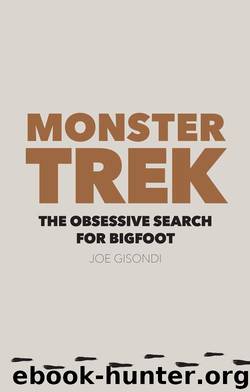
Author:Joe Gisondi
Language: eng
Format: mobi, azw3, epub
Tags: SOC022000 Social Science / Popular Culture
ISBN: 9780803285194
Publisher: UNP - Nebraska
Published: 2016-02-01T07:00:00+00:00
5
Northern Wisconsin
Looking out over the bog, I wonder, Would I have pulled the trigger if I had a bigfoot in the crosshairs of a high-powered rifle? We’re standing by the spot where Don Young says he faced that exact dilemma here in northern Wisconsin. This is the same Don Young who had been scared out of the woods a few years earlier after bigfoot had allegedly eaten some family cats, had nearly broken the back of his dog, and had chased Don up a tree. It’s late morning on Labor Day 2009. The sky is blue, the temperature is cool enough to require jeans. Leaves on trees have already started to turn vibrant red and gold, about a month ahead of central Illinois. A few weeks later, this area would endure a hard frost. We’re about an hour from Lake Superior, farther north than I have ever traveled. We’re also about an hour from a sizable city. Wausau, eight-five miles away, is the largest city in northern Wisconsin with about thirty-eight thousand residents. Eau Claire, with sixty-two thousand residents, is 114 miles away to the west. Just north of Wassau, U.S. 51 just sort of ends, dropping from six lanes to two and looking more like a rural county road than the northern tip of a 1,286-mile road that started in New Orleans. This region is filled with tiny towns like Phillips, whose population is about 1,700, Lac du Flambeau (3,004), Butternut (407), Prentice (509), and Catawba (149). You’ll find far more wildlife than people in northern Wisconsin and far, far more hardwood forests and wetlands than driveways and drive-thrus. To the north, the Chequamegon-Nicolet National Forest covers 1.5 million acres inhabited by hundreds of black beer and tens of thousands of deer — or about twenty-four deer per square mile. The Northern Highland American Legion State Forest and Ottawa National Forest cover about another five hundred thousand acres in the north and east. Several other state parks and recreation areas add more than one hundred thousand acres of protected woods. Outside the parks, a great deal of the area remains unspoiled and wild.
One can get easily get lost in northern Wisconsin. That’s why it was a favorite refuge for gangsters in the 1920s and ’30s. Al Capone hid away near Couderay, about an hour’s drive west, while John Dillinger and Baby Face Nelson holed up in Manitowish Waters, an hour’s drive northeast. If you want to get lost, come to northern Wisconsin. Clearly, bigfoot got the message. Unlike Capone and Baby Face, bigfoot are not as well known in the area. An ecologist for the state’s Department of Natural Resources dismissed Don’s bigfoot sighting, telling me he had never heard of any reports. “Interesting,” he said. “Being the heart of northern Wisconsin, though, I’m guessing the observer saw Paul Bunyan, and not a bigfoot.”
Several years earlier, that was Don Young’s perspective — that it was far more likely someone would see the folkloric lumberjack than a mythical beast. That was before Don wandered across bigfoot twice in a year.
Download
Monster Trek: The Obsessive Search for Bigfoot by Joe Gisondi.azw3
Monster Trek: The Obsessive Search for Bigfoot by Joe Gisondi.epub
This site does not store any files on its server. We only index and link to content provided by other sites. Please contact the content providers to delete copyright contents if any and email us, we'll remove relevant links or contents immediately.
Animal Frequency by Melissa Alvarez(4437)
Sigil Witchery by Laura Tempest Zakroff(4219)
Real Magic by Dean Radin PhD(4109)
Fingerprints of the Gods by Graham Hancock(3972)
Aleister Crowley: The Biography by Tobias Churton(3613)
Journeys Out of the Body by Robert Monroe(3600)
The Rosicrucians by Christopher McIntosh(3499)
Alchemy and Alchemists by C. J. S. Thompson(3494)
Mysteries by Colin Wilson(3432)
Hitler's Monsters by Eric Kurlander(3309)
The Hatha Yoga Pradipika (Translated) by Svatmarama(3301)
John Dee and the Empire of Angels by Jason Louv(3152)
Wicca: a guide for the solitary practitioner by Scott Cunningham(3151)
Infinite Energy Technologies by Finley Eversole(2961)
Book of Life by Deborah Harkness(2903)
Dark Star Rising by Gary Lachman(2850)
The Book of Lies by Aleister Crowley(2823)
Aliens by Jim Al-Khalili(2808)
To Light a Sacred Flame by Silver RavenWolf(2798)
